crackmes.one CTF 2026 - crackme9
This year I participated in the crackmes.one CTF, a reverse engineering similar to Flare-On. Crackme9 was one of the harder challenges, with 43 solves by the end of the CTF.
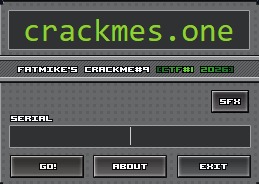
As usual, we’re given a prompt to enter a serial number. Tracing through the function that checks the serial, we can see a call to a function at the address 0x40a000. This address is not part of the .text section of the PE file; instead, it occurs at the start of a nonstandard section called .pc. Looking at a hex dump of the .pc section, it was obviously encrypted.
99 ae 95 d7 80 31 f7 5c 3b c9 38 6e 9a 11 56 06  .....1.\;.8n..V.
16 81 d5 0c eb 59 b4 fa fe da 10 89 de 78 32 6b  .....Y.......x2k
87 bb fb e6 09 19 77 a9 84 33 4a dc 91 7b 8b 5a  ......w..3J..{.Z
6d 5c 4a 94 ed ee cd 5e d8 5e f5 c2 8b bc 35 15  m\J....^.^....5.
39 7c 1b 08 bd 76 29 5d 66 13 0c 14 c1 f3 93 c6  9|...v)]f.......
98 71 b1 26 83 bf c7 20 b9 a6 8b 91 cc 05 7f 20  .q.&... .......
b7 74 0c 6d ea 66 b3 34 aa 03 18 25 23 4f 45 26  .t.m.f.4...%#OE&
84 4a 2e 47 db 99 9d 97 6c 37 3a d3 84 ac 17 67  .J.G....l7:....g
Initial deobfuscation steps
API resolution
I started off by setting breakpoints on commonly used APIs like VirtualAlloc and VirtualProtect. Tracing through the calls, I found that the APIs were being resolved through some kind of indirect lookup function.
0040112c    int32_t do_VirtualProtect()

0040112f        sub_401367()
0040113c        jump(sub_401ad3(&data_40d1a8))
As usual for this type of challenge, the APIs were being called based on their hash, in this case 0x10066f2f for VirtualProtect.
00401ad3    int32_t __fastcall sub_401ad3(int32_t* arg1)

00401ae6        if (arg1[5] != 0)
00401aeb            return arg1[5]
00401aeb
00401b20        void* var_14
00401b20        arg1[5] = sub_401175(sub_401ca2(*arg1, &var_14, 0x10066f2f))
00401b26        return arg1[5]
Looking at the hash function at sub_401ba9, it turned out to just be unmodified CRC32:
00401ba9    uint32_t __stdcall sub_401ba9(char* arg1, int32_t arg2)

00401bad        int32_t esi = 0
00401baf        uint32_t edx = 0xffffffff
00401bb3        char* edi = arg1
00401bb3
00401bb9        if (arg2 u> 0)
00401bbb            int32_t ebx
00401bbb            int32_t var_10_1 = ebx
00401bbb
00401be6            do
00401bbc                ebx.b = edi[esi]
00401bc1                int32_t i_1 = 8
00401bdd                int32_t i
00401bdd
00401bdd                do
00401bc7                    uint32_t ecx_2 = edx u>> 1
00401bc9                    char eax_2 = ebx.b ^ edx.b
00401bcd                    edx = ecx_2 ^ 0xedb88320
00401bcd
00401bd5                    if ((eax_2 & 1) == 0)
00401bd5                        edx = ecx_2
00401bd5
00401bd8                    ebx.b u>>= 1
00401bda                    i = i_1
00401bda                    i_1 -= 1
00401bdd                while (i != 1)
00401bdf                edi = arg1
00401be2                esi += 1
00401be6            while (esi u< arg2)
00401be6
00401bf0        return not.d(edx)
Since CRC32 is such a widely used algorithm, we can use HashDB to look up the API names that go with each checksum. In fact, there’s a Binary Ninja plugin that pulls data from HashDB to define an enum mapping all the API names to their checksums.
enum hashdb_strings_crc32 : uint32_t
{
    FlushInstructionCache = 0xe9258e7a,
    RtlMoveMemory = 0x1c0cd35c,
    GlobalUnWire = 0x2c82f5fb,
    MapUserPhysicalPages = 0xafd472a5,
    // [...]
    RtlUniform = 0xd09d867b,
    RtlNewSecurityObjectEx = 0x8733c5dd,
    WinSqmSetEscalationInfo = 0x648930f1
};
Normally I’d write a script to rename all the API hashing functions to their respective API names, but in this case there weren’t that many of them so I just renamed them all by hand.
Breakpoints
When left to run under a debugger, the binary runs until it hits an int3 breakpoint at 0x4037c6. I’d seen things like this before where exceptions are used to obfuscate control flow, but the binary seemed to be “getting stuck”, never progressing past the breakpoint location.
004037c2    void __fastcall do_breakpoint(void* arg1)

004037c2  c6410101           mov     byte [ecx+0x1], 0x1
004037c6  cc                 int3
When I was resolving the API hashes, I saw that KiUserExceptionDispatcher was one of the hashed APIs, so I looked at how that was being used. It looked like the binary was supposed to overwrite the entry point of KiUserExceptionDispatcher with an exception handler of its own. However, for whatever reason the overwrite function wasn’t being called, so the real KiUserExceptionDispatcher was being called instead.
00402ce0    void __fastcall overwrite_KiUserExceptionDispatcher(char* hook)

00402ce6        if (*hook == 0)
00402ce6            return
00402ce6
00402cef        int32_t KiUserExceptionDispatcher
00402cef        int80_t st0_1
00402cef        st0_1, KiUserExceptionDispatcher =
00402cef            get_KiUserExceptionDispatcher(&kernel32_addr, get_kernel32_baseaddr())
00402cfd        _memcpy_s(KiUserExceptionDispatcher, 6, &hook[1], 6)
00402d05        *hook = 0
It turned out the KiUserExceptionDispatcher overwrite was only called if an anti-debug check was passed. The check used NtQueryInformationProcess, which I had thought could be bypassed with ScyllaHide, but for whatever reason that didn’t work in this case. Ultimately, I just patched out the check entirely.
00402b6d    int32_t __fastcall check_ProcessDebugPort(int32_t* arg1)

00402b77        if (sub_402bc7(arg1) != 0)
00402b7c            return 1
00402b7c
00402b88        int32_t* ProcessInformation = arg1
00402b89        int32_t esi
00402b89        int32_t var_c = esi
00402b8a        ProcessInformation = nullptr
00402b91        get_dll_baseaddr()
00402b98        HANDLE ProcessHandle = do_GetCurrentProcess()
00402b9f        get_dll_baseaddr()
00402bb1        NTSTATUS result = do_NtQueryInformationProcess(ProcessHandle,
00402bb1            ProcessInformationClass: ProcessDebugPort, &ProcessInformation,
00402bb1            ProcessInformationLength: 4, ReturnLength: nullptr)
00402bb1
00402bb9        if (result != STATUS_SUCCESS)
00402bc3            result.b = 0
00402bc6            return result
00402bc6
00402bbe        result.b = ProcessInformation != result
00402bc2        return result
At that point, the custom exception handler was being called, but the binary still crashed soon after with mysterious access violation exceptions. It seemed like it was trying to decrypt and run the .pc section, but the decryption was incorrect.
00402e1c    void decrypt_and_ntcontinue(PCONTEXT arg1) __noreturn

00402e20        context_record = arg1
00402e28        exception = __return_addr
00402e2d        get_cipher_ctx()
00402e40        decrypt_from_exception(ctx: &cipher_ctx, exception: exception,
00402e40            context: context_record)
00402e45        get_dll_baseaddr()
00402e54        do_NtContinue(ContextRecord: context_record, TestAlert: 0)
00402e59        breakpoint
The .pc section
Decrypting the code
At some point in the reversing process I got pretty stuck, and I was just kind of clicking around the decompilation for a while looking for something comprehensible. I eventually found something I recognized at sub_401e67:
00401e67    uint32_t* __thiscall sub_401e67(uint32_t* arg1, char* arg2, char* arg3)

00401e72        int32_t var_14 = 0xb979379e
00401e7c        int32_t var_10 = 0x157c4a7f
00401e83        int32_t var_c = 0x60c09cf3
00401e8a        int32_t var_8 = 0x34c8ed5c
00401e96        *arg1 = bytes_to_int(&var_14)
00401ea1        arg1[1] = bytes_to_int(&var_10)
00401ead        arg1[2] = bytes_to_int(&var_c)
00401ebd        arg1[3] = bytes_to_int(&var_8)
00401ec5        arg1[4] = bytes_to_int(arg2)
00401ed1        arg1[5] = bytes_to_int(&arg2[4])
00401edd        arg1[6] = bytes_to_int(&arg2[8])
00401ee9        arg1[7] = bytes_to_int(&arg2[0xc])
00401ef5        arg1[8] = bytes_to_int(&arg2[0x10])
00401f01        arg1[9] = bytes_to_int(&arg2[0x14])
00401f0d        arg1[0xa] = bytes_to_int(&arg2[0x18])
00401f1d        arg1[0xb] = bytes_to_int(&arg2[0x1c])
00401f20        arg1[0xc] = 0
00401f27        arg1[0xd] = 0
00401f33        arg1[0xe] = bytes_to_int(arg3)
00401f42        arg1[0xf] = bytes_to_int(&arg3[4])
00401f4a        return arg1
This function takes a 32-byte array and an 8-byte array, and uses them alongside a 16-byte constant to initialize an array of 64 bytes. If you’ve reversed enough cryptography code before, you’ll likely recognize this as the initialization of a ChaCha20 matrix. Normally the constant used in ChaCha20 is the string expand 32-byte k, but I guess the challenge author thought that would be too easy to search for, so here it’s replaced by the custom constant 0xb979379e, 0x157c4a7f, 0x60c09cf3, 0x34c8ed5c.
Looking at where the ChaCha20 matrix is initialized, the nonce is hard-coded as 0a 0b 0c 0d 0e 0f 10 11, but the key is retrieved from a global variable.
00404059    char* __thiscall do_chacha_with_hprov_key(struct cipher_ctx* ctx, int32_t ciphertext)

00404069        char* ciphertext_buf = do_malloc(ctx->len)
00404077        memcpy(dest: ciphertext_buf, src: ciphertext, count: ctx->len)
00404087        int32_t counter_1 = ciphertext - *ctx->pc_ptr
0040408c        int64_t nonce
0040408c        nonce.d = 0xd0c0b0a
00404093        nonce:4.d = 0x11100f0e
0040409a        get_crypt_context()
004040ad        struct matrix matrix
004040ad        init_chacha_matrix_with_counter(&matrix, key: get_key_from_hprov(&hprov), &nonce,
004040ad            counter0: 0, counter1: 0)
004040ba        chacha_rotated_counter(&matrix, counter_1, counter_2: 0)
004040c8        do_chacha_encrypt(&matrix, ciphertext: ciphertext_buf, len: 0x10)
004040d3        return ciphertext_buf
I found that the key was being stored alongside an HCRYPTPROV handle obtained from CryptAcquireContextA, and that other Crypto API functions were being called to generate the key itself.
00403388    BOOL __convention("regparm") hash_something_for_chacha_key(int32_t arg1, int32_t* arg2 @ ebp, char* arg3 @ esi, char* arg4 @ edi)

00403388        *0xff45c6 = arg1
00403395        arg2[-3] = 0
004033a5        get_dll_baseaddr()
004033aa        arg2[-5] = 0x40d1a0
004033b2        arg2[-4] = *arg2[-2]
004033c5        arg2[-5]
004033c8        BOOL result = do_CryptCreateHash(hProv: arg2[-4], Algid: 0x800c, hKey: 0,
004033c8            dwFlags: 0, phHash: &arg2[-3])
004033c8
004033cf        if (result != 0)
004033de            get_dll_baseaddr()
004033e3            arg2[-9] = 0x40d1a0
004033e9            arg2[-8] = arg2[-3]
004033f7            arg2[-9]
004033f7
00403401            if (do_CryptHashData(hHash: arg2[-8], pbData: arg2[-7], dwDataLen: arg2[-6],
00403401                    dwFlags: 0) != 0)
0040340c                arg2[-0xa] = 0x20
00403420                get_dll_baseaddr()
00403425                arg2[-0xc] = 0x40d1a0
0040342b                arg2[-0xb] = arg2[-3]
00403440                arg2[-0xc]
00403443                do_CryptGetHashParam(arg2[-0xb], 2, arg2[-2] + 4, &arg2[-0xa], 0)
00403443
00403456            get_dll_baseaddr()
0040345b            arg2[-0xe] = 0x40d1a0
00403461            arg2[-0xd] = arg2[-3]
00403467            arg2[-0xe]
0040346a            result = do_CryptDestroyHash(arg2[-0xd])
0040346a
00403473        *arg2
00403474        return result
Setting a breakpoint on CryptHashData, it turned out the ChaCha20 key was the SHA-256 hash of the .text section of the executable. This is an anti-debug measure, as setting software breakpoints changes the contents of .text.
When I tried dumping the .text section from the binary and hashing it, the resulting hash didn’t result in a valid decryption. Looking more closely in x64dbg at the data that was being hashed, I found that the last byte of the section had been changed from 0x00 to 0x90. Making the same change to my copy of the .text section, I got the correct key F630AA38D57297375D645559C334FD50D55CA1D177D2655A042351CF69244BF2. (For the actual decryption step, I used CryptoTester, which supports custom-constant ChaCha20 out of the box.)
Running the code
Single stepping
Now that I had the right key, I could see how the program tried to run the decrypted code. The program obtains the ChaCha20 key with a call to CryptGetHashParam, so I set a breakpoint on CryptGetHashParam’s return to patch in the correct hash. To make things easier, I eventually figured out that I could set the breakpoint to run a command to write to the hash address, so that I wouldn’t have to manually do the patch on every run. The syntax to do this in x64dbg is:
set 0x40d268,#F630AA38D57297375D645559C334FD50D55CA1D177D2655A042351CF69244BF2#
However, even with the correct key, the program didn’t decrypt and run the .pc section all at once. Instead, it only decrypted it 16 bytes at a time, and wrote only those few instructions to the buffer it had allocated for running shellcode.
004040ad        init_chacha_matrix_with_counter(&matrix, key: get_key_from_hprov(&hprov), &nonce,
004040ad            counter0: 0, counter1: 0)
004040ba        chacha_rotated_counter(&matrix, counter_1, counter_2: 0)
004040c8        do_chacha_encrypt(&matrix, ciphertext: ciphertext_buf, len: 0x10)
004040d3        return ciphertext_buf
Moreover, the program seemed to only be running one instruction at a time before allocating a new shellcode buffer with VirtualAlloc. For example, out of the first 16 bytes that are decrypted, only the instruction mov eax,ecx is run at first.
3E4C0006 | 8BC1                     | mov eax,ecx                             |
3E4C0008 | C741 04 90B16E0A         | mov dword ptr ds:[ecx+4],A6EB190        |
3E4C000F | C700 00000000            | mov dword ptr ds:[eax],0                |
3E4C0015 | 0000                     | add byte ptr ds:[eax],al                |
3E4C0017 | 0000                     | add byte ptr ds:[eax],al                |
3E4C0019 | 0000                     | add byte ptr ds:[eax],al                |
Then, a new buffer is allocated to run the next instruction mov dword ptr ds:[ecx+4],A6EB190, and so on.
17100002 | C741 04 90B16E0A         | mov dword ptr ds:[ecx+4],A6EB190        |
17100009 | C741 08 336C4720         | mov dword ptr ds:[ecx+8],20476C33       |
17100010 | 0000                     | add byte ptr ds:[eax],al                |
17100012 | 0000                     | add byte ptr ds:[eax],al                |
17100014 | 0000                     | add byte ptr ds:[eax],al                |
In order to run a single instruction at a time before stopping execution, the program uses the same mechanisms that debuggers use to perform single steps. The CPU has a flag called the trap flag that tells it to execute a single instruction before raising an exception of type EXCEPTION_SINGLE_STEP. (You can see an example of how a debugger might use this flag here.) Sure enough, the trap flag is set before each run of the decrypted shellcode.
004037fa    uint32_t __stdcall set_context_flags(CONTEXT* arg1)

00403804        *(arg1->ContextFlags + 0x18) = 0
00403809        *(arg1->ContextFlags + 0x14) = 0
0040380e        *(arg1->ContextFlags + 4) = 0
00403811        uint32_t ContextFlags = arg1->ContextFlags
00403813        *(ContextFlags + 0xc0) |= 0x100
0040381e        return ContextFlags
Control flow obfuscation
Even after decryption, the decompilation of the .pc section didn’t make much sense. The code was full of int3 breakpoints, which were usually followed by nonsensical disassembly.
0040a0cb  mov     eax, dword [ebp-0x8]
0040a0ce  and     eax, 0x80000003
0040a0d3  int3
0040a0d4  fisttp  dword [eax-0x7d], st0
0040a0d7  enter   0x40fc, 0x85
0040a0db  ror     ah, 0x38
Upon closer inspection in x64dbg, several bytes were being skipped each time the program executed an int3 breakpoint. For instance, after the breakpoint at 0x40a035 was executed, the next instruction to be run was the push dword ptr [ebp+8] instruction at 0x40a037, with the address 0x40a036 being skipped over entirely.
Looking at the exception handler code again, there were different functions for retrieving the next .pc instruction depending on whether the exception was an int3 breakpoint or a single step.
00404562    void __thiscall decrypt_from_exception(struct cipher_ctx* ctx, int32_t* exception, CONTEXT* context)

00404569        if (ctx->field_8 != 0)
00404569            return
00404569
00404574        if (*exception == STATUS_BREAKPOINT)
00404579            chacha_breakpoint(ctx, context)
00404574        else if (*exception == STATUS_SINGLE_STEP)
0040458b            chacha_single_step(ctx, context)
00404586        else if (*exception == STATUS_GUARD_PAGE_VIOLATION)
0040459a            CONTEXT* context_1 = context
0040459e            chacha_guard_page_violation(ctx, exception)
Unlike the single-step handler, which just set context->Eip to the next instruction before returning, the breakpoint handler called another function to determine the next instruction pointer before returning.
004042ec    int32_t __thiscall chacha_breakpoint(struct cipher_ctx* ctx, CONTEXT* context)

004042fe        if (sub_4037b2(ctx->field_24) == 0)
00404318            CONTEXT* exception_context = context
00404318
00404328            if (check_context_eip_in_range(ctx, eip: exception_context->Eip) != 0)
0040432d                breakpoint_set_eip(ctx, exception_context)
00404332                CONTEXT* context_1 = context
00404335                uint32_t Eip = context_1->Eip
0040433b                uint32_t Eip_1 = Eip
0040433f                ctx->Eip = Eip
00404342                chacha_and_flush_cache(ctx, context: context_1)
004042fe        else
00404304            flush_instruction_cache(ctx, &context)
00404309            ctx->field_24
00404310            set_context_flags(&context)
00404310
0040434d        return 0xffffffff
Looking at the breakpoint_set_eip function at 0x4045f3, it was retrieving a value from a map, then setting the next instruction to one of two locations pulled from that map.
004045f3    struct map_val* __thiscall breakpoint_set_eip(struct cipher_ctx* ctx, CONTEXT* exception_context)

004045f7        CONTEXT* exception_context_1 = exception_context
00404608        struct map_val* result =
00404608            get_map_data(ctx, key: (exception_context_1->Eip).w - (ctx->baseaddr).w)
00404608
00404611        if (result != 0)
00404622            int32_t offset
00404622
00404622            if (check_eflags(result, exception_context_1) == 0)
0040462c                offset = result->offset_2
00404622            else
00404627                offset = result->offset_1 + result->offset_2
00404627
0040463c            flush_process_cache(ctx, &exception_context, offset + exception_context_1->Eip)
00404641            result.b = 1
00404611        else
00404613            result.b = 0
00404613
00404647        return result
Dumping the map data from the debugger, it contained a long list of structures of four integer values. The first integer was the map key, corresponding to the address of the .pc instruction currently being executed (minus the base address of 0x400000). The third and fourth integers were the two choices of addresses to jump to.
00 A0 00 00 01 00 00 00 2F 00 00 00 02 00 00 00
01 A0 00 00 12 00 00 00 49 00 00 00 02 00 00 00
02 A0 00 00 0A 00 00 00 72 00 00 00 02 00 00 00
03 A0 00 00 0A 00 00 00 43 00 00 00 02 00 00 00
04 A0 00 00 05 00 00 00 5A 00 00 00 02 00 00 00
The second integer, which was always a value between 1 and 18, was used for deciding which of the two offsets to jump to. Depending on its value, different combinations of the flags in the eflags register were checked, and the decision for where to jump was made based on the value of those flags.
00404166    uint32_t __stdcall check_eflags(struct map_val* arg1, CONTEXT* arg2)

00404172        uint32_t EFlags = arg2->EFlags
00404178        uint32_t choice = arg1->field_4 - 1
00404178
0040417c        if (choice u> 0x11)
00404238            choice.b = 0
0040417c        else
00404182            switch (choice)
004041ea                case 0
004041ea                    EFlags u>>= 6  // ~ZF
004041ed                    goto get_negated_flag
00404234                case 1
00404234                    choice.b = 1
00404189                case 2
0040418c                    EFlags.b = (EFlags u>> 7).b & 1  // SF
0040418f                    choice.b = EFlags.b

// [...]

004041a2                case 0x10
004041a5                    if ((1 & (EFlags u>> 6).b) != 0)  // ZF
004041b7                        choice.b = 0
004041a5                    else
004041af                        // ~ (OF ^ SF)
004041af                        choice.b = (EFlags u>> 0xb).b ^ (EFlags u>> 7).b
004041af
004041b3                        if ((1 & choice.b) == 0)
004041b7                            choice.b = 1
004041b3                        else
004041b7                            choice.b = 0
0040418c                case 0x11
0040418c                    EFlags.b &= 1
0040418f                    choice.b = EFlags.b
0040418f
0040423b        return choice
The combinations of flags that were being checked were, in fact, the exact combinations of flags that are checked in ordinary x86 branch instructions. For example, in the switch case above, case 0 corresponds to the condition ZF = 0, which is used in the conditional branch instruction JNZ. Similarly, case 0x10 corresponds to the condition ZF = 0 and SF = OF, which is the conditional JG.
Essentially, every single branch instruction in the .pc section had been replaced with a breakpoint, and the branch logic was being handled in the exception handler. Since this is a one-to-one replacement of one assembly instruction with another, the most logical way to deal with it would’ve been to patch the original branch instructions back in, except that the branch instructions were longer than the breakpoint instructions replacing them.
Reversing the check algorithm
Emulating with Unicorn
Since I couldn’t think of a good way to patch the binary in a way that would get me a reasonable-looking decompilation, I decided to try to emulate the .pc section in Unicorn, adding a hook to intercept the breakpoint instructions and resolve the branches. I had to hook a couple of external functions like strlen, but luckily there weren’t too many of those, so I didn’t have to do much extra work other than the usual boilerplate that comes with setting up Unicorn.
from unicorn import *
from unicorn.x86_const import *
from capstone import *
import struct

def to_int(b):
    return hex(int.from_bytes(b, 'little'))

jumps = { 0: 'jnz', 1: 'jmp', 2: 'js', 3: 'jae', 4: 'jle', 5: 'ja', 6: 'jge', 7: 'jp', 8: 'jo', 9: 'jbe', 10: 'jecxz', 11: 'jnp', 12: 'jz', 13: 'jl', 14: 'jns', 15: 'jno', 16: 'jg', 17: 'jb' }

def get_bit(val, bit):
    return (val >> bit) & 1

def get_branch_cond(cond, flags, ecx):
    if cond == 0: # jnz
        return get_bit(flags, 6) == 0
    elif cond == 1: # jmp
        return True
    elif cond == 2: # js
        return get_bit(flags, 7) != 0
    elif cond == 3: # jae
        return get_bit(flags, 0) == 0
    elif cond == 4: # jle
        return get_bit(flags, 6) == 0 or (get_bit(flags, 0xb) != get_bit(flags, 0x7))
    elif cond == 5: # ja
        return get_bit(flags, 6) == 0 and get_bit(flags, 0) == 0
    elif cond == 6: # jge
        return get_bit(flags, 7) == get_bit(flags, 0xb)
    elif cond == 7: # jp
        return get_bit(flags, 2) != 0
    elif cond == 8: # jo
        return get_bit(flags, 0xb) != 0
    elif(cond == 9): # jbe
        return get_bit(flags, 6) != 0 or get_bit(flags, 0) != 0
    elif(cond == 10): # jecxz
        return ecx == 0
    elif(cond == 11): # jnp
        return get_bit(flags, 2) == 0
    elif(cond == 12): # jz
        return get_bit(flags, 6) != 0
    elif(cond == 13): # jl
        return get_bit(flags, 0xb) != get_bit(flags, 0x7)
    elif(cond == 14): # jns
        return get_bit(flags, 7) == 0
    elif(cond == 15): # jno
        return get_bit(flags, 0xb) == 0
    elif(cond == 16): # jg
        return get_bit(flags, 6) == 0 and (get_bit(flags, 0xb) == get_bit(flags, 0x7))
    elif(cond == 17): # jb
        return get_bit(flags, 0) != 0
    else:
        raise ValueError("invalid condition", cond)

offsets = {}
f = open('data.bin', 'rb').read()
for i in range(0, len(f), 0x10):
    data = f[i:i+0x10]
    key, cond, jump, base = struct.unpack('<4i', data)
    offsets[key + 0x400000] = (cond, jump, base)

def emu_push(mu: Uc, val):
    esp = mu.reg_read(UC_X86_REG_ESP)
    mu.mem_write(esp - 4, val.to_bytes(4, 'little'))
    mu.reg_write(UC_X86_REG_ESP, esp - 4)

def emu_pop(mu: Uc):
    esp = mu.reg_read(UC_X86_REG_ESP)
    val = mu.mem_read(esp, 4)
    mu.reg_write(UC_X86_REG_ESP, esp + 4)
    return int.from_bytes(val, 'little')

def emu_return(mu: Uc):
    ret_addr = emu_pop(mu)
    mu.reg_write(UC_X86_REG_EIP, ret_addr)

def hook_strlen(uc):
    print('Skipping strlen function')
    uc.reg_write(UC_X86_REG_EAX, 0x13)

def hook_crypt(uc):
    #print('Skipping crypto setup')
    uc.reg_write(UC_X86_REG_EAX, HPROV)

def hook_hash(uc):
    #print('Skipping hash function')
    uc.reg_write(UC_X86_REG_EAX, MEM)

def hook_pass(uc):
    pass

def hook_mem_write(mu: Uc, access, address, size, value, user_data):
        data_bytes = value.to_bytes(size, 'little')
        print(f'[{hex(mu.reg_read(UC_X86_REG_EIP))}] Address {hex(address)}: Wrote {data_bytes.hex()}')

def hook_mem_read(mu: Uc, access, address, size, value, user_data):
    if address >= MEM and address < MEM + 0x10:
        data_bytes = mu.mem_read(address, size)
        print(f'[{hex(mu.reg_read(UC_X86_REG_EIP))}] Address {hex(address)}: Read {data_bytes.hex()}')

def hook_code(mu: Uc, address, size, user_data):
    for i in md.disasm(mu.mem_read(address, size), address):
        print("0x%x:\t%s\t%s" % (i.address, i.mnemonic, i.op_str))
        print('\teax:', hex(mu.reg_read(UC_X86_REG_EAX)))
        print('\tebx:', hex(mu.reg_read(UC_X86_REG_EBX)))
        print('\tecx:', hex(mu.reg_read(UC_X86_REG_ECX)))
        print('\tedx:', hex(mu.reg_read(UC_X86_REG_EDX)))
        ebp = mu.reg_read(UC_X86_REG_EBP)
        esp = mu.reg_read(UC_X86_REG_ESP)
        print(f'\tebp: {to_int(mu.mem_read(ebp, 4))}  ebp - 4: {to_int(mu.mem_read(ebp - 4, 4))}    ebp - 8: {to_int(mu.mem_read(ebp - 8, 4))}    ebp - c: {to_int(mu.mem_read(ebp - 0xc, 4))}    ebp - 10: {to_int(mu.mem_read(ebp - 0x10, 4))}    ebp - 0x14: {to_int(mu.mem_read(ebp - 0x14, 4))}')
        print(f'\tstack: +0: {to_int(mu.mem_read(esp, 4))}    +4: {to_int(mu.mem_read(esp + 4, 4))}    +8:  {to_int(mu.mem_read(esp + 8, 4))}     +c: {to_int(mu.mem_read(ebp + 0xc, 4))} ')

        if i.mnemonic == 'call': # skip external function calls
            target = i.operands[0].imm
            if target in hooks:
                hooks[target](mu)
                mu.reg_write(UC_X86_REG_EIP, i.address + i.size)

def hook_interrupt(mu: Uc, intno, user_data):
    if intno == 3:
        eip = mu.reg_read(UC_X86_REG_EIP) - 1
        cond, jump, base = offsets[eip]
        not_taken_addr = eip + base
        taken_addr = eip + base + jump
        #print(hex(eip), hex(not_taken_addr), hex(taken_addr))

        ecx = mu.reg_read(UC_X86_REG_ECX)
        flags = mu.reg_read(UC_X86_REG_EFLAGS)

        should_branch = get_branch_cond(cond - 1, flags, ecx)
        if should_branch:
            print(f'Branch {jumps[cond - 1]} taken: {hex(taken_addr)}')
            mu.reg_write(UC_X86_REG_EIP, taken_addr)
        else:
            print(f'Branch {jumps[cond - 1]} not taken: {hex(not_taken_addr)}')
            mu.reg_write(UC_X86_REG_EIP, not_taken_addr)


sc = open('shellcode.bin', 'rb').read()

md = Cs(CS_ARCH_X86, CS_MODE_32)
md.detail = True

hooks = {
    0x409731: hook_strlen,
    0x403477: hook_crypt,
    0x40a4b5: hook_hash
}

BASE = 0x40a000
BASE_SIZE = 1024*1024
STACK_ADDR = 0x40000000
STACK_SIZE = 1024*1024

MEM = 0x60000000
MEM_SIZE = 1024*1024

HPROV = MEM + 0x100
CONSTS = MEM + 0x2000

def emu(start):
    mu = Uc(UC_ARCH_X86, UC_MODE_32)

    mu.mem_map(STACK_ADDR, STACK_SIZE)
    mu.reg_write(UC_X86_REG_ESP, STACK_ADDR + STACK_SIZE // 2)
    mu.reg_write(UC_X86_REG_EBP, STACK_ADDR + STACK_SIZE // 2 - 0x1000)

    mu.mem_map(MEM, MEM_SIZE)
    mu.mem_write(MEM, b'ABCD-4567-89ab-cdef')
    mu.mem_write(STACK_ADDR + STACK_SIZE // 2 + 4, MEM.to_bytes(4, 'little'))

    KEY = bytes.fromhex('F630AA38D57297375D645559C334FD50D55CA1D177D2655A042351CF69244BF2')
    mu.mem_write(HPROV + 4, KEY)
    mu.mem_write(HPROV + 0x24, (MEM+0x1000).to_bytes(4, 'little'))
    mu.mem_write(HPROV + 0x28, b'\x00\x8a\x00\x00')

    mu.mem_write(CONSTS, bytes.fromhex('47bb5d8690b16e0a336c472093768a1cfbbdfe59'))
    mu.reg_write(UC_X86_REG_ECX, CONSTS)

    mu.mem_map(BASE, BASE_SIZE)
    mu.mem_write(BASE, sc)

    mu.hook_add(UC_HOOK_CODE, hook_code)
    mu.hook_add(UC_HOOK_INTR, hook_interrupt)

    mu.hook_add(UC_HOOK_MEM_READ, hook_mem_read)

    mu.emu_start(start, BASE+BASE_SIZE)

emu(0x40a025)
Unfortunately, this approach turned out to be largely unhelpful. I could tell that the serial was supposed to be 19 characters long (consistent with something of the format XXXX-XXXX-XXXX-XXXX), and that the characters were being hashed in groups of four, but the hash algorithm didn’t match up with anything I recognized.
I did notice that the .pc section started with a function that loaded five random-looking values, though, so I figured those were the target values for the hash.
0040a000    int32_t* __convention("fastcall") sub_40a000(int32_t* arg1)

0040a000  c70147bb5d86       mov     dword [ecx], 0x865dbb47  {0x865dbb47}
0040a006  8bc1               mov     eax, ecx
0040a008  c7410490b16e0a     mov     dword [ecx+0x4], 0xa6eb190
0040a00f  c74108336c4720     mov     dword [ecx+0x8], 0x20476c33
0040a016  c7410c93768a1c     mov     dword [ecx+0xc], 0x1c8a7693
0040a01d  c74110fbbdfe59     mov     dword [ecx+0x10], 0x59febdfb
0040a024  c3                 retn     {__return_addr}
Fixing the decompilation
After a while I gave up on emulation and came back to the idea of trying to decompile the code again. I couldn’t figure out a way to patch in the branch instructions without overwriting too many other instructions, so instead I decided to see if I could modify the Binary Ninja IL somehow.
In Binary Ninja, the code to be decompiled is lifted through several different forms of IL as it’s being processed. In theory, there are APIs to edit IL instructions at any stage of the analysis process. Since the modification I wanted to make was supposed to be equivalent to a simple binary patch, I thought it would make the most sense to modify the lowest level of IL, called Lifted IL. However, when I looked through the documentation on how to do so, I found that it explicitly advised against it:
You probably do not want to modify Lifted IL with a Workflow. Instead, consider modifying the Architecture directly (most of which are Open Source on our GitHub) or making your Activity modify Low Level IL.
“Modifying the Architecture directly” sounded promising, so I looked at how the x86 architecture plugin generated IL instructions.
The code for how breakpoints were handled turned out to be very straightforward: for each INT3 breakpoint instruction, a single IL breakpoint instruction is emitted. To fix it, I would need to modify that line to emit an IL branch instruction instead.
case XED_ICLASS_INT3:
	il.AddInstruction(il.Breakpoint());
	break;
Conveniently, the code for handling branch instructions is right next to the breakpoint code, and it includes a convenient switch case listing all the ways to construct an IL conditional branch from its corresponding x86 branch.
case XED_ICLASS_JO:
	ConditionalJump(arch, il, il.FlagCondition(LLFC_O), addrSize, branchDestination, addr + instLen);
	return false;

case XED_ICLASS_JNO:
	ConditionalJump(arch, il, il.FlagCondition(LLFC_NO), addrSize, branchDestination, addr + instLen);
	return false;

// [...]

case XED_ICLASS_JECXZ:
	ConditionalJump(arch, il, il.CompareEqual(4, il.Register(4, XED_REG_ECX), il.Const(4, 0)), addrSize, branchDestination, addr + instLen);
	return false;

case XED_ICLASS_JRCXZ:
	ConditionalJump(arch, il, il.CompareEqual(8, il.Register(8, XED_REG_RCX), il.Const(8, 0)), addrSize, branchDestination, addr + instLen);
	return false;
To generate the branch instructions, I started by adding a hard-coded map of all the breakpoint addresses in the .pc section and their corresponding branch types, as well as an enum containing all the conditions.
#include <map>
#include <cstdint>

struct CrackmeCond {
    int cond;
    int not_taken;
    int taken;
};

const uint64_t CRACKME_SC_START = 0x40a000;
const uint64_t CRACKME_SC_END = 0x40a5ff;

enum class JumpCond: int {
    JNZ = 0,
    JMP,
    JS,
    JAE,
    JLE,
    JA,
    JGE,
    JP,
    JO,
    JBE,
    JECXZ,
    JNP,
    JZ,
    JL,
    JNS,
    JNO,
    JG,
    JB
};

std::map<int, CrackmeCond> conds = {
    { 0x40a000, { 1, 2, 49 } },
    { 0x40a001, { 18, 2, 75 } },
    { 0x40a002, { 10, 2, 116 } },
    { 0x40a003, { 10, 2, 69 } },
    { 0x40a004, { 5, 2, 92 } },
    { 0x40a005, { 3, 2, 34 } },
    { 0x40a006, { 18, 2, 161 } },
    // [...]
    { 0x40a5fd, { 7, 2, 130 } },
    { 0x40a5fe, { 13, 2, 52 } },
    { 0x40a5ff, { 13, 2, 46 } },
};
I then modified the breakpoint handling code to add a switch case modeled after Binary Ninja’s own code for handling x86 conditional branch instructions, calling ConditionalJump with the arguments I had parsed out of the map whenever a breakpoint fell within the range of addresses in the .pc section.
case XED_ICLASS_INT3:
	if(addr >= CRACKME_SC_START && addr < CRACKME_SC_END)
	{
		const auto cond_struct = conds[addr];
		const auto cond = static_cast<JumpCond>(cond_struct.cond - 1);
		const auto taken_addr = addr + cond_struct.taken;
		const auto not_taken_addr = addr + cond_struct.not_taken;

		switch(cond)
		{
			case JumpCond::JMP:
				il.AddInstruction(il.Jump(il.ConstPointer(addrSize, taken_addr)));
				break;

			case JumpCond::JO:
				ConditionalJump(arch, il, il.FlagCondition(LLFC_O), addrSize, taken_addr, not_taken_addr);
				break;

				// [...]

			case JumpCond::JECXZ:
				ConditionalJump(arch, il, il.CompareEqual(4, il.Register(4, XED_REG_ECX), il.Const(4, 0)), addrSize, taken_addr, not_taken_addr);
				break;

			default:
				il.AddInstruction(il.Breakpoint());
		}
	}
	else
	{
		il.AddInstruction(il.Breakpoint());
	}

	break;
After making this modification, the LLIL breakpoint instructions were replaced with LLIL branches, which repaired the control flow of the binary.
6 @ 0040a02e  [ebp - 0x14 {var_18}].d = ecx
7 @ 0040a031  [ebp + 8 {serial}].d
8 @ 0040a035  breakpoint
6 @ 0040a02e  [ebp - 0x14 {var_18}].d = ecx
7 @ 0040a035  if ([ebp + 8 {serial}].d == 0) then 8 @ 0x40a045 else 10 @ 0x40a037
This worked far better than I expected it to, resulting in coherent decompilation! It wasn’t perfect by any means, but it was good enough for me to reimplement the algorithm. The trace I’d printed out from Unicorn turned out to be helpful after all, as it gave me values to test against in the steps where the decompilation was ambiguous.
0040a025    int32_t __stdcall do_check(int32_t arg1 @ ecx, int32_t serial)

0040a025        int32_t ebp
0040a025        int32_t var_4 = ebp
0040a026        struct struct_1* ebp_1 = &var_4
0040a02b        void* entry_ebx
0040a02b        void* var_28 = entry_ebx
0040a02c        int32_t entry_esi
0040a02c        int32_t var_2c = entry_esi
0040a02d        int32_t edi
0040a02d        int32_t var_30 = edi
0040a02d        int32_t* esp_1 = &var_30
0040a02e        int32_t var_18 = arg1
0040a035        int32_t result
0040a035
0040a035        if (serial == 0)
0040a045            result.b = 0
0040a035        else
0040a03f            esp_1 = &var_30
0040a03f
0040a043            if (0x409731(serial) == 0x13)
0040a04c                int32_t var_8_1 = 0
0040a053                int32_t var_c_1 = 0
0040a05a                int32_t var_14_1 = 0
0040a061                int32_t var_10_1 = 0xcafebabe
0040a061
0040a06f                while (true)
0040a06f                    sub_40a4b5(0x403477())
0040a06f
0040a080                    if (ebp_1->serial_char == 0)
0040a08a                        ebp_1->serial_char = 1
0040a080                    else if (ebp_1->serial_char == 1)
0040a0ae                        *(esp_1 - 4) = zx.d(*(ebp_1->acc + ebp_1->count))
0040a0af                        *(esp_1 - 8) = ebp_1->i
0040a0ba                        ebp_1->i = do_char_hash(ebp_1->field_c)
0040a0c1                        ebp_1->count += 1
0040a0ce                        int32_t done_yet = ebp_1->count & 0x80000003
0040a0ce
0040a0d3                        if (done_yet s< 0)
0040a0d9                            done_yet = ((done_yet - 1) | 0xfffffffc) + 1
0040a0d9
0040a0dc                        if (done_yet == 0)
0040a0e6                            // go to compare-and-multiply
0040a0e6                            ebp_1->serial_char = 2
0040a0dc                        else if (ebp_1->count != 0x13)
0040a10f                            // if not all chars hashed, resume loop
0040a10f                            ebp_1->serial_char = 1
0040a0f3                        else
0040a0fe                            ebp_1->serial_char = 3
0040a09a                    else if (ebp_1->serial_char != 2)  // state 3: check
0040a178                        if (ebp_1->serial_char != 3)
0040a178                            break
0040a178
0040a17a                        *(esp_1 - 4) = 4
0040a186                        ebp_1->field_0 = ebp_1->field_c[*(esp_1 - 4)]
0040a199                        int32_t check_result = ebp_1->field_10 | (ebp_1->i ^ ebp_1->field_0)
0040a19b                        ebp_1->field_10 = check_result
0040a19b
0040a19e                        if (check_result != 0)
0040a1a9                            ebp_1->serial_char = 5  // wrong
0040a19e                        else
0040a1a0                            ebp_1->serial_char = 4  // right
0040a11f                    else  // state 2: get compare val and multiply
0040a124                        void* eax_11
0040a124                        int32_t edx_1
0040a124                        edx_1:eax_11 = sx.q(ebp_1->count)
0040a12a                        unimplemented  {sar eax, 0x2}
0040a12e                        ebp_1->field_8 = ((eax_11 + (edx_1 & 3)) s>> 2) - 1
0040a13a                        // save compare_val into ebp_1 - 0x1c?
0040a13a                        ebp_1->field_4 = *(ebp_1->field_c + (ebp_1->field_8 << 2))
0040a151                        ebp_1->field_10 |= ebp_1->i ^ ebp_1->field_4
0040a168                        ebp_1->i = ebp_1->count * 0x112233 - 0x35014542
0040a16b                        ebp_1->serial_char = 1
0040a16b
0040a1b6                if (ebp_1->serial_char != 4)
0040a1be                    result.b = 0
0040a1b6                else
0040a1b8                    result.b = 1
0040a043            else
0040a045                result.b = 0
0040a045
0040a1c7        *esp_1
0040a1c7        esp_1[1]
0040a1c8        esp_1[2]
0040a1ca        ebp_1->field_20
0040a1cb        return result
Reimplementation
The hash was a weird ad-hoc algorithm that made different decisions about how to process each character depending on certain ranges of values that it fell into. This means that the initial approach I took with Unicorn would never have worked very well on its own, as the flow of execution is completely different depending on whether each of the characters in the serial are letters, numbers, special characters and so on. There’s even a special case that specifically handles the character 0x30.
The presence of all the weird conditionals also means that the hash can’t be cracked using constraint solvers. (My initial reimplementation of the algorithm was in Python with the intent of solving it with z3, which resulted in confusing error statements like Symbolic expressions cannot be cast to concrete Boolean values.) Luckily, only 4 characters are hashed at a time, so I rewrote my implementation in C and bruteforced each group of characters.
#include <stdio.h>
#include <stdint.h>

uint32_t hash_round(uint32_t acc, uint32_t c) {
    if((acc & 1) != 0) {
        if((acc ^ c) <= 0x80000000) {
            if((c >= 0x61) && (c <= (0x61 + 26))) {
                acc -= c;
            }
            else if((c < 0x41) || (c > (0x41 + 26))) {
                acc *= 9;
            }
            else {
                acc += c;
                if((acc & 0x100) != 0) {
                    acc ^= 0x13371337;
                }
            }
        }
        else if(c > 0x60) {
            acc = (c * 0x21) ^ (acc + 0xdeadbeef);
        }
        else {
            acc += 0xdeadbeef;
        }
    }
    else {
        if(c >= 0x40) {
            if(c % 2 != 0) {
                acc = ((acc >> 5) | (acc << 0x1b)) ^ 0x87654321;
            }
            else {
                acc = ((acc << 3) | (acc >> 0x1d)) + 0x12345678;
            }
        }
        else if((c & 2) == 0) {
            acc -= (c << 4);
            if(c == 0x30) {
                acc |= 0xf0f0f0f0;
            }
        }
        else {
            acc ^= 0x55aa55aa;
            acc += c;
        }
    }

    uint32_t mod_5 = (c % 5) + 2;
    for(uint32_t i = 0; i < mod_5; i++) {
        if((acc & 0x80000000) == 0) {
            acc <<= 1;
        }
        else {
            acc = (acc << 1) ^ 0x4c11db7;
        }

        uint32_t mask = i & 0x80000001;
        if(mask != 0) {
            acc += i * 0xa;
        }
        else {
            acc ^= c;
        }
    }

    uint32_t count = acc;
    count ^= (count >> 0x10);
    count ^= (count >> 0x8);

    if((count & 0xf) > 7) {
        acc = ~acc;
    }

   return acc;
}

uint32_t hash(char* data, uint32_t pos, uint32_t len) {
    uint32_t acc = 0xcafebabe + 0x112233 * 4 * pos;
    for(uint32_t i = 0; i < len; i++) {
        acc = hash_round(acc, data[i]);
    }

    return acc;
}

int check_val(uint32_t expected, uint32_t pos, uint32_t len) {
    for(char i = 0x20; i < 0x7f; i++) {
        //printf("trying %x\n", i);
        for(char j = 0x20; j < 0x7f; j++) {
            for(char k = 0x20; k < 0x7f; k++) {
                for(char l = 0x20; l < 0x7f; l++) {
                    char to_try[4] = {i, j, k, l};
                    uint32_t acc = hash(to_try, pos, len);
                    if(acc == expected) {
                        printf("%c%c%c%c", i, j, k, l);
                        return 0;
                    }
                }
            }
        }
    }

    return -1;
}

int main() {
    uint32_t compares[5] = {0x865dbb47, 0xa6eb190, 0x20476c33, 0x1c8a7693, 0x59febdfb};

    for(int i = 0; i < 4; i++) {
        if(check_val(compares[i], i, 4) == -1) {
            return -1;
        }
    }

    if(check_val(compares[4], 4, 3) == -1) {
        return -1;
    }

    return 0;
}
This gets us the serial: D3FE-A7ED-BAAD-C0D3. Entering it into the crackme, we finally have our flag!
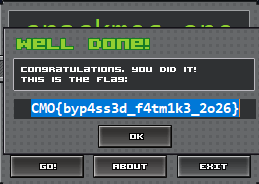
CMO{byp4ss3d_f4tm1k3_2o26}
Note: After the CTF, I found out that the control flow obfuscation came from an obfuscator called Nanomites, the source code of which was on the challenge author’s GitHub long before the CTF started. I’ll have to remember to check for that next time.